

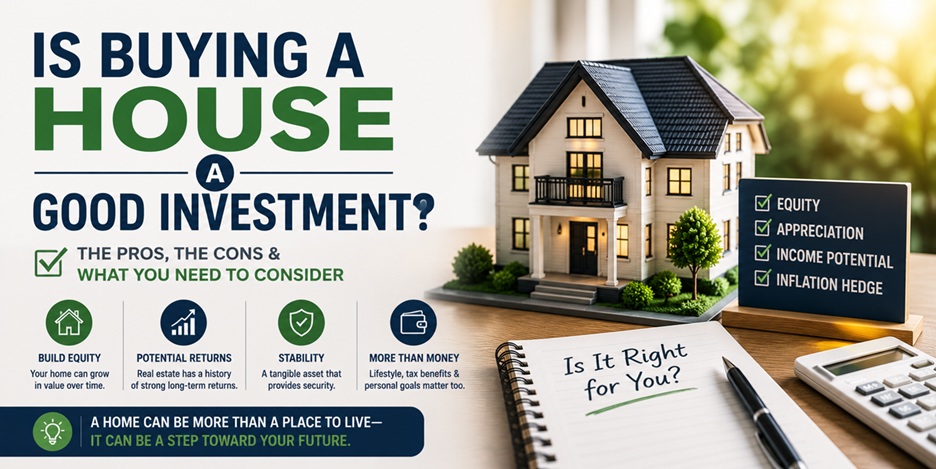
Buying a primary residence is a reasonable financial decision for most people who plan to stay 5+ years — but calling it an “investment” oversells it. Historically, U.S. home values have appreciated roughly in line with inflation (about 3–4% annually), well below stock market returns of 7%+ over the same periods. The financial case for a primary residence rests less on appreciation and more on forced savings, leverage, tax treatment, and avoiding rent.
The current environment makes the comparison messier. With mortgage rates near 6–7% and home prices still elevated relative to incomes, the monthly cost of owning often exceeds the monthly cost of renting in many markets. That doesn’t mean buying is wrong, but the “renting is throwing money away” frame is genuinely outdated in many cities right now.
The Real Returns Components
A house’s financial return comes from four sources, not just appreciation:
| Component | What It Contributes |
|---|---|
| Price appreciation | ~3–4% per year historically (varies hugely by market) |
| Mortgage paydown | Forced equity buildup over time |
| Tax treatment | Mortgage interest, property tax deductions (if itemizing) |
| Imputed rent | The rent you don’t pay to a landlord |
Of these, “imputed rent” is the underappreciated one. Owning means you don’t pay rent — and that ongoing benefit accumulates regardless of what the home’s market price does.
What “Good Investment” Actually Compares Against
Stock market historically: ~7% real return per year. U.S. home prices historically: ~1% real return per year, before owner expenses.
A pure financial investor would put $300,000 in index funds, not in a primary residence. But comparing the two ignores that you have to live somewhere — the real comparison is buying vs. renting, not buying vs. investing.
The Buy vs. Rent Comparison
The right framework includes monthly housing cost in both scenarios, opportunity cost of the down payment, maintenance/property tax/insurance (typically 1–3% of home value annually), transaction costs (6–10% to sell), mobility costs, and tax benefits if any.
The 5-year rule of thumb: if you’ll be in the home less than 5 years, buying usually loses to renting because transaction costs eat too much of any appreciation. Beyond 5–7 years, the math tilts toward buying in most markets — though “most” doesn’t mean “all.”
Where Buying Tends to Win
- Stable markets with moderate price-to-rent ratios
- You plan to stay 7+ years
- You can afford a meaningful down payment (20%+)
- You’re disciplined about not over-buying
- The local rental market is tight or expensive
Where Buying Tends to Lose
- High-priced coastal markets where price-to-rent ratios exceed 25
- Career stages requiring mobility
- Markets with declining populations or industries
- Homes priced at your absolute maximum affordability (no margin for repairs)
Hidden Costs Most Buyers Underestimate
| Cost | Annual Estimate |
|---|---|
| Property tax | 0.5%–2.5% of home value |
| Homeowners insurance | 0.3%–1% of home value |
| Maintenance and repairs | 1%–2% of home value |
| HOA fees (if applicable) | $0–$10,000+ |
| Utilities (often higher than renting) | Varies |
A $400,000 home likely costs $8,000–$16,000 a year in ownership costs beyond the mortgage. Buyers focused only on “principal and interest” often miss this until the first major repair.
The Forced-Savings Angle
The strongest case for homeownership isn’t appreciation — it’s behavioral. Most Americans don’t save consistently. A mortgage forces equity buildup whether you want it or not. Twenty years in, even modest home appreciation plus mortgage paydown often produces meaningful net worth — primarily because the alternative (renting and investing the difference) didn’t actually happen.
If you’re someone who will reliably invest the down payment and the monthly difference between rent and ownership cost, renting + investing usually beats owning financially. If you’re someone who won’t, ownership tends to outperform your actual rental-plus-spending alternative.
Bottom Line
A primary residence is a reasonable place to put money, but it’s not a great pure investment. The right frame: you’re buying a place to live with some financial benefits, not buying an asset that happens to be habitable. If you plan to stay 5+ years, can afford it comfortably (not stretching), and the local rent-vs-buy math works, it’s a sound decision. If you’re stretching to make the down payment, planning to move soon, or buying because “renting is throwing money away,” reconsider.