

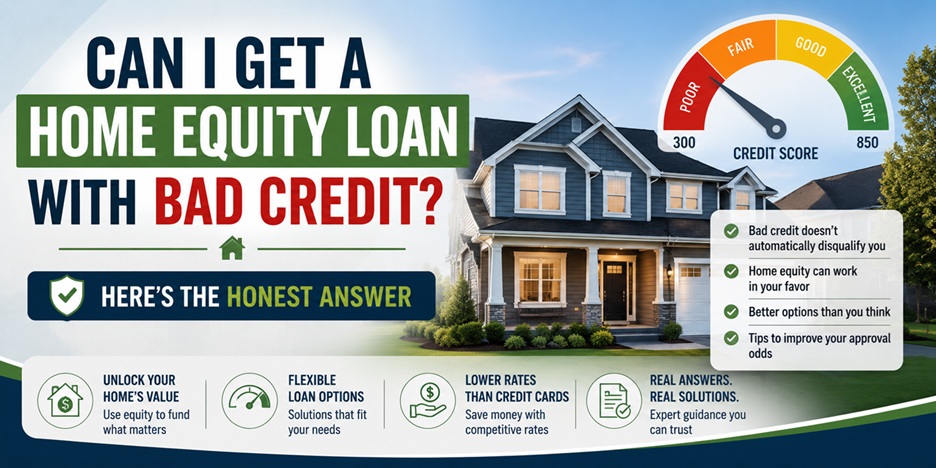
Yes, you can – if your credit score is 580 or higher and you have at least 15–20% equity remaining in your home after the new loan. Below 580, options narrow sharply but don’t disappear. Above 620, most lenders will at least consider you.
Three factors matter alongside the score: equity, debt-to-income ratio, and income stability. If two of those three are strong, a weak credit score becomes a rate problem, not an approval problem.
The Quick Decision Tree
| Your Credit Score | Most Likely Outcome | Your Move |
|---|---|---|
| Below 580 | Very limited; specialty lenders only | Fix score first, or try FHA cash-out refi |
| 580–619 | Possible with strong equity + low DTI | Apply at credit unions, portfolio lenders |
| 620–679 | Approved at most lenders, higher rate | Apply at 2–3 lenders to compare |
| 680+ | Standard approvals available | Shop for best rate |
The 3 Things That Offset Bad Credit
High equity (over 30% remaining after the new loan). A lender lending you 60% of your home’s value sleeps better than one lending you 85% — that gap matters more than a 40-point score difference.
Low DTI (under 35%). Your monthly debt as a percentage of gross income. This is the single most fixable number on your application. Paying off one credit card can drop it 5–10 points.
Stable income (2+ years). Same job, same industry, same self-employment business. Underwriters discount higher scores when the income history is choppy.
Check all three boxes, and even a 580 score can get approved. Check only one, and the score has to do more of the work.
What You’ll Likely Sacrifice
- Higher rate — typically 2 to 4 percentage points above prime-borrower rates
- Lower max LTV — most lenders cap bad-credit borrowers at 80% CLTV instead of 85%
- More documentation — expect more paperwork than a clean-credit borrower
- Possible origination fees — some specialty lenders charge 1–3% upfront
Smart First Move
Before applying anywhere, pull your credit report at AnnualCreditReport.com (free, real, no upsell). Look for:
- Accounts you don’t recognize
- Late payments older than 7 years (should be off your report)
- Balances reporting higher than what you actually owe
- Duplicate collection entries
Disputing legitimate errors can move your score 20–40 points in 30 days. That alone might bump you from “denied” to “approved at a reasonable rate.”
Where to Apply
If a national bank has already turned you down, don’t take that as final. Try:
- A credit union you qualify for — Navy Federal, PenFed, local options
- A portfolio lender — community banks that hold their own loans and set their own rules
- Online lenders with published bad-credit programs — they exist and they advertise floors clearly
National banks have the tightest credit-score rules. They’re not the right first stop with sub-680 credit.
A Reality Check
A home equity loan is secured by your home. Missing payments isn’t a “they ding your credit” event — it’s a foreclosure-risk event. If your credit is bad because of unstable income, borrow only what your budget can absorb in a slow month. If losing your main income source means you can’t cover the payment, the loan amount is too big.
Bottom Line
Bad credit narrows your options but doesn’t end them, especially at 580 and above. Strengthen what you control (DTI, documentation, lender choice), accept that you’ll pay a rate premium, and don’t borrow up to your approval cap just because the lender says you can.